It can be accessed by this link http://creator.zoho.com/roshan_padmanabhan/page/17/
Wednesday, August 22, 2007


Monday, June 04, 2007
10 myths abt global warming
10 MYTHS about Global WarmingDon't believe these commonly heard statements:
| |
15 Very Important Things to Do about Global Warming...from the individual to the national 1. Learn about it -- start with this Web site and see the References. 2. Sell the SUV and choose cleaner, more efficient vehicles. Reduce your driving: one gallon of gas burned creates 20 pounds of CO2. Fuel up on ethanol and biodiesel. 3. Use efficient appliances, replace light bulbs with low-voltage compact fluorescents, check your home insulation. Buy renewable energy, like wind and solar, from your power company. 5. Companies -- the one you work for and the ones you buy from -- can save lots of money and reduce global warming by taking similar steps toward energy efficiency. 6. Shop smart: Look for products made from recycled materials, created with renewable energy, and which help you save money and reduce pollution. 7. Use your vote and influence as a citizen to elect responsive leaders; help them organize the neighborhood and town for energy efficiency. 8. Suburban sprawl makes for lots of global warming pollution; plan for walkable communities, lots of trees, open spaces, and public transportation in and between cities. 10. Build new homes and buildings for efficiency and solar power. 11. Support sustainable farming and forestry, including new crops to make into ethanol and other biofuels. 12. Let the corporations who make our cars, fuels, goods and power know you want their products to be as ecological as possible. 13. At all government levels, develop an efficient energy policy, moving away from fossil fuels. 14. Export new energy technology that uses renewable energy sources to the rest of the world. 15. ....and start doing these things today. | 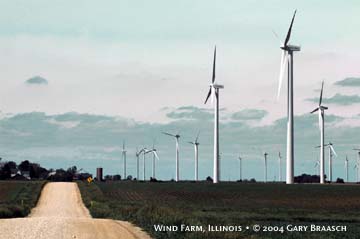 |
What can we do?
Each of can play a role in dealing with and slowing climate change. Each of us must. Right now, the best source for practical actions that can be adopted by individuals, groups, cities, businesses, and governments is the book Stormy Weather by Guy Dauncy and Patrick Mazza, published last year by New Society Publishers. The authors have a Web site which lists their recommendations, plus a great amount of climate information, at | |
Technologies to Combat Global Warming (first of a series)
Wind turbines are being installed worldwide at an increasing rate. Wind is the fastest growing energy technology in the world today. In recent years, wind capacity worldwide has more than doubled. The towers must be located to protect migrating birds and bats, and scenic landscapes -- which unfortunately early wind farms like Altamont California did not consider. This technology can increase the use and value of open farm and grazing land (see above in Illinois), and is also compatible with solar installations.
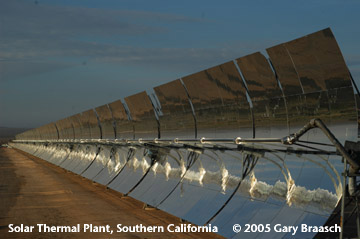
Another older solar electric generation system is the solar- thermal Kramer Junction array of five fields of 33 megawatts each in the Mojave desert. It has been on line since 1985 to produce electricity for the Southern California Edison power grid supplying the greater Los Angeles area. This technology uses parabolic mirrors to heat an oil which makes steam to run turbines.
| |
Photographs from the World View of Global Warming are available for license to publications needing science photography, environmental groups and agencies, and other uses. Stock photography and assignments available. Please contact info@worldviewofglobalwarming.org or Gary Braasch Photography (503) 699-6666. Use of photographs in any manner, in part or whole, without permission is prohibited by US copyright law. These photographs are registered with the US Copyright Office and are not in the Public Domain. | |
Gary Braasch, Photographer PO Box 1465 Portland, OR 97207 USA USA Phone: 503.699.6666 Cell: 503.860.1228 | |

 Increasingly nations and governments have been adopting technologies to deal with global warming. Some large installations are strictly defensive, like the Thames River Barrier protecting London, built beginning in 1982. At first it was used rarely, less than once a year, but British Science Advisor Sir David King says it is now closed against high tides 6 or 7 times a year.
 Solar is also growing and offers the flexibility of scale, from small panels for individual appliances in homes to huge acreages supplying cities and industries. The two forms of solar illustrated here are the photovoltaic panel used in the array on the roof of the Moscone Convention Center in San Francisco. This is the largest civic owned solar installation in the US. Its 60,000 square feet generates 675 kilowatts of electricity, and saves $210,000 a year over conventional electric sources.
 It must be mentioned that the largest sources of non-fossil fuel energy are ancient -- water power and wood. These supply most of the so-called renewable energy in the world despite the obvious negative (and not always renewable or reversible) effects on rivers and forests. Stay tuned to World View of Global Warming for increasing details on clean energy solutions and success stories.
Saturday, June 02, 2007
Jagooo.............

BARE TRUTH: These two pictures — one taken in 1968 (top) and the other in 2007 — show the retreating Rongbuk Glacier of Mount Everest on the Tibetan plateau. The rugged Tibet plateau, seen as a sensitive barometer of the impact of global warming, is experiencing accelerating glacial melt and other ecological changes. The mountainous region's glaciers have been melting at an annual average rate of 131.4 square km over the last 30 years
Personalized genome
http://www.medicalnewstoday.com/healthnews.php?newsid=72842
James Watson, Nobel Laureate and co-discoverer with Francis Crick of the DNA double helix was presented this week with his own genome sequence.

Watson, who is also the father of the Human Genome project, is the first human to be given the data that surrounds his own personal genome sequence.
The project to unravel Watson's DNA took two months and cost 1 million US dollars. It was a joint effort between 454 Life Sciences, a US subsidiary of the Swiss pharmaceutical company Roche AG, based in Connecticut, and another American organization, the Baylor College of Medicine (BCM) Human Genome Sequencing Center (HGSC) in Houston, Texas.
Watson, who is 79, and Francis Crick, who died in 2004, won the Nobel Prize in 1962 for their discovery of the DNA double helix.
"I'm thrilled," he said, when he received his genome sequence at a presentation at the BCM on Wednesday.
Apart from the personal significance of the project to Watson, the presentation marks the technological progress that has been made since the completion of the Human Genome Project (HGP) in 2003. The HGP took 13 years to complete and cost 3 billion dollars. Time and cost of such projects are expected to tumble as the technology improves, and it may soon be feasible to sequence anyone's genome. This is the vision being pursued by sequencing firms.
"Personalized genomes span the gulf between genetic diagnostics and genomics," said Dr Richard Gibbs, director of the HGSC and a scientific advisor to 454 Life Sciences.
"This project brings together research genetics, genetic diagnostics and genomics into the new vision of personal medicine. All of that is embodied in this project," he added.
A full report on the project, together with comments on the important ethical implications of doing this kind of work will be appearing soon. The raw data that describes the DNA sequence of Watson's genome is already available for anyone to see in the GenBank National Center for Biotechnology Information Trace Archive.
Jonathan Rothberg, founder and former chairman of 454 Life Sciences said that when he thought of the 454 sequencing technology, he "envisioned making routine individual genome sequencing a reality to help with personal medical care".
"Since Dr Watson is the co-discoverer of DNA's structure and a 1962 Nobel Laureate, it is only appropriate to work with him on this ambitious genome sequencing project. This project will pave the way for exploring life at the ultimate level by uncovering what makes each individual unique," he added.
Scientists produced the raw sequence using DNA from a sample of Watson's blood. The 454 method circumvents the long and expensive process of bacterial cloning of DNA which was used in the original HGP, where the genome was segmented into smaller pieces that were then inserted into bacteria cells where the bacteria's DNA replicators then copied them to produce the numbers necessary for sequencing to take place.
Instead, the method developed by 454 Life Sciences uses a polymerase chain reaction where enzymes replicate the DNA and the copies are then fed into a new DNA sequencing plate where a complex process of chemical amplification and computer-based decoding takes place to identify the sequence of 3 billion base pairs of the genome.
HGSC examined the sequence produced by the 454 Life Sciences method to check that it covered the whole genome, which also served to validate the new technology.
An important part of the process is the ethical "envelope" surrounding the revelation of a person's genome. Once the code is known, then it is possible to search for presence of genes for diseases, which may or may not be known to the person. Diseases such as cystic fibrosis and muscular dystrophy occur when a person has the faulty gene from both parents. If they only have one faulty gene for the disease, because it is recessive, they will not have the disease, but they will be a carrier.
But what if they don't know they are a carrier, should they be told? Are there some things they would rather not know about? If so, then how is the confidentiality and informed consent side of things going to be handled? These are the kinds of questions that will have to be addressed if genomic sequencing becomes common practice in the future, and in that way this project has served as a prototype.
The ethical procedure was also handled by HGSC who consulted with James Watson. There were some things he did not wish to know, and these were omitted from the sequencing data. For instance he did not wish to know if he carried the gene that signifies a higher risk of Alzheimer's since the disease is incurable and one of his grandmothers had it.
Dr Amy McGuire, assistant professor of medical ethics at BCM said: "There will be a host of ethical and social questions as we move into the phase of integrating this kind of information into clinical in the future."
Apparently some of Watson's genes did show risk for cancer. He has had skin cancer and his sister has had breast cancer, he said at the ceremony. However, it is unlikely that the type of cancer he was likely to have would have been predictable from knowing his genome sequence.
Click here for the GenBank National Center for Biotechnology Information Trace Archive.
Click here for more information on the Human Genome Project.
James Watson, Nobel Laureate and co-discoverer with Francis Crick of the DNA double helix was presented this week with his own genome sequence.

Watson, who is also the father of the Human Genome project, is the first human to be given the data that surrounds his own personal genome sequence.
The project to unravel Watson's DNA took two months and cost 1 million US dollars. It was a joint effort between 454 Life Sciences, a US subsidiary of the Swiss pharmaceutical company Roche AG, based in Connecticut, and another American organization, the Baylor College of Medicine (BCM) Human Genome Sequencing Center (HGSC) in Houston, Texas.
Watson, who is 79, and Francis Crick, who died in 2004, won the Nobel Prize in 1962 for their discovery of the DNA double helix.
"I'm thrilled," he said, when he received his genome sequence at a presentation at the BCM on Wednesday.
Apart from the personal significance of the project to Watson, the presentation marks the technological progress that has been made since the completion of the Human Genome Project (HGP) in 2003. The HGP took 13 years to complete and cost 3 billion dollars. Time and cost of such projects are expected to tumble as the technology improves, and it may soon be feasible to sequence anyone's genome. This is the vision being pursued by sequencing firms.
"Personalized genomes span the gulf between genetic diagnostics and genomics," said Dr Richard Gibbs, director of the HGSC and a scientific advisor to 454 Life Sciences.
"This project brings together research genetics, genetic diagnostics and genomics into the new vision of personal medicine. All of that is embodied in this project," he added.
A full report on the project, together with comments on the important ethical implications of doing this kind of work will be appearing soon. The raw data that describes the DNA sequence of Watson's genome is already available for anyone to see in the GenBank National Center for Biotechnology Information Trace Archive.
Jonathan Rothberg, founder and former chairman of 454 Life Sciences said that when he thought of the 454 sequencing technology, he "envisioned making routine individual genome sequencing a reality to help with personal medical care".
"Since Dr Watson is the co-discoverer of DNA's structure and a 1962 Nobel Laureate, it is only appropriate to work with him on this ambitious genome sequencing project. This project will pave the way for exploring life at the ultimate level by uncovering what makes each individual unique," he added.
Scientists produced the raw sequence using DNA from a sample of Watson's blood. The 454 method circumvents the long and expensive process of bacterial cloning of DNA which was used in the original HGP, where the genome was segmented into smaller pieces that were then inserted into bacteria cells where the bacteria's DNA replicators then copied them to produce the numbers necessary for sequencing to take place.
Instead, the method developed by 454 Life Sciences uses a polymerase chain reaction where enzymes replicate the DNA and the copies are then fed into a new DNA sequencing plate where a complex process of chemical amplification and computer-based decoding takes place to identify the sequence of 3 billion base pairs of the genome.
HGSC examined the sequence produced by the 454 Life Sciences method to check that it covered the whole genome, which also served to validate the new technology.
An important part of the process is the ethical "envelope" surrounding the revelation of a person's genome. Once the code is known, then it is possible to search for presence of genes for diseases, which may or may not be known to the person. Diseases such as cystic fibrosis and muscular dystrophy occur when a person has the faulty gene from both parents. If they only have one faulty gene for the disease, because it is recessive, they will not have the disease, but they will be a carrier.
But what if they don't know they are a carrier, should they be told? Are there some things they would rather not know about? If so, then how is the confidentiality and informed consent side of things going to be handled? These are the kinds of questions that will have to be addressed if genomic sequencing becomes common practice in the future, and in that way this project has served as a prototype.
The ethical procedure was also handled by HGSC who consulted with James Watson. There were some things he did not wish to know, and these were omitted from the sequencing data. For instance he did not wish to know if he carried the gene that signifies a higher risk of Alzheimer's since the disease is incurable and one of his grandmothers had it.
Dr Amy McGuire, assistant professor of medical ethics at BCM said: "There will be a host of ethical and social questions as we move into the phase of integrating this kind of information into clinical in the future."
Apparently some of Watson's genes did show risk for cancer. He has had skin cancer and his sister has had breast cancer, he said at the ceremony. However, it is unlikely that the type of cancer he was likely to have would have been predictable from knowing his genome sequence.
Click here for the GenBank National Center for Biotechnology Information Trace Archive.
Click here for more information on the Human Genome Project.
Saturday, May 19, 2007
Big Melt in Antartica
Big melt in Antarctica
May 18, 2007
taken from :- http://www.alaskareport.com/do77811_antarctica.htmCourtesy of Far North Science
By Doug O'Harra
Here's more heating news, this time from the cryosphere of the Far South, a region thought to be much cooler than the Far North and not as responsive to greenhouse gas influences.
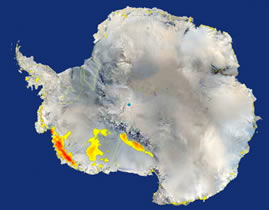 NASA's QuikScat satellite detected extensive areas of snowmelt, shown in yellow and red, in west Antarctica in January 2005. NASA/JPL
 A team of rocket scientists from NASA's Jet Propulsion Laboratory and university researchers detected a massive snow meltdown on the ice covering West Antarctica, ultimately sloshing up an area larger than the state of California.
It was caused by warm temperatures in January 2005 - the peak of the austral summer.
"This was the first widespread Antarctic melting ever detected with NASA's QuikScat satellite and the most significant melt observed using satellites during the past three decades," NASA reported in a news release about the finding.
The team was led by JPL's Son Nghiem and Konrad Steffen, director of the Cooperative Institute for Research in Environmental Sciences at the University of Colorado, Boulder, led the team. Their study, "Snow Accumulation and Snowmelt Monitoring in Greenland and Antarctica," appears in the recently published book Dynamic Planet.
 QuikScat / NASA-JPL
QuikScat satellite data helps scientists measure whether ice sheets in Antarctica and Greenland accumulate snow and gain mass - or melt enough during summer that they actually lose mass. In this study, the team tracked snowfall and melt in Antarctica and Greenland from July 1999 through July 2005.
What they found about that brief warm spell in January 2005 was stunning - air temperatures that reached 41 °F, above-freezing air that lasted more than a week at a time.
"The observed melting occurred in multiple distinct regions, including far inland, at high latitudes and at high elevations, where melt had been considered unlikely," they reported in a news release. "Evidence of melting was found up to 900 kilometers (560 miles) inland from the open ocean, farther than 85 degrees south (about 500 kilometers, or 310 miles, from the South Pole) and higher than 2,000 meters (6,600 feet) above sea level."
"Antarctica has shown little to no warming in the recent past with the exception of the Antarctic Peninsula, but now large regions are showing the first signs of the impacts of warming as interpreted by this satellite analysis," Steffen said.
"Increases in snowmelt, such as this in 2005, definitely could have an impact on larger-scale melting of Antarctica's ice sheets if they were severe or sustained over time."
A different JPL study found in 2006 that overall Antarctica ice sheets had lost mass for the first time.
Here's how the QuikScat process worked:
The satellite's scatterometer instrument sends radar pulses to the ice sheet surface, measuring the echoed pulses that bounce back. When snow melts and then refreezes, it changes to ice, just as ice cream crystallizes when it is left out too long and is then refrozen. QuikScat can differentiate this icy fingerprint in the snow cover and can map on a continental scale the extent of strong snowmelt and the subsequently formed ice layer. Available ground station measurements validate the satellite results.
The 2005 melt was intense enough to create an extensive ice layer when water refroze after the melt. However, the melt was not prolonged enough for the melt water to flow into the sea.
"Water from melted snow can penetrate into ice sheets through cracks and narrow, tubular glacial shafts called moulins," Steffen said. "If sufficient melt water is available, it may reach the bottom of the ice sheet. This water can lubricate the underside of the ice sheet at the bedrock, causing the ice mass to move toward the ocean faster, increasing sea level."
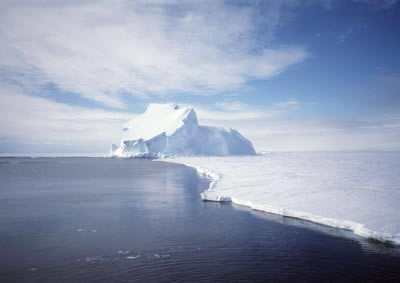 Antarctica JPL / Ben Holt, Sr.
Antarctica holds most of the Earth's freshwater locked in ice and snow. If that water were to melt and be released to the ocean, global sea level could rise by scores of meters. Ocean currents, climate, storm patterns and seawater salinity would be altered on a vast scale.
The NASA-Colorado team has detected no additional melting through March 2007, according to Nghiem. But they need to keep watching.
"Satellite scatterometry is like an X-ray that sees through snow and finds ice layers beneath as early as possible," he said. "It is vital we continue monitoring this region to determine if a long-term trend may be developing."
Sunday, January 28, 2007
Animals of Madagascar
About 75 percent of the species found in Madagascar live nowhere else on the planet. http://www.wildmadagascar.org
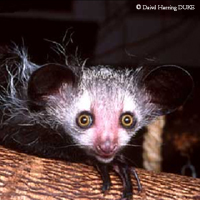 | Aye-aye Take the ears of a bat and the teeth of a rat, add a long bony middle finger and huge eyes and you have yourself the aye-aye. This nocturnal lemur lives in the rainforests of Madagascar and feeds on insect larvae that it finds by tapping on tree bark with its stick-like middle finger. As it taps, the aye-aye listens for movement indicative of insects and gnaws away at the wood when it hears something appetizing. Today the aye-aye is highly threatened by habitat loss (rainforest destruction) and hunting. In some areas, local people believe the aye-aye brings bad luck and will kill the animal whenever they encounter it. MORE | |
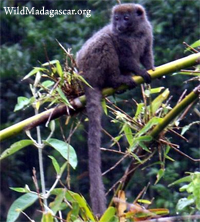 | Bamboo lemur Bamboo lemurs feed on bamboo and are generally found in the rainforests and cloud forests of Madagascar (two species are found outside these areas). MORE | |
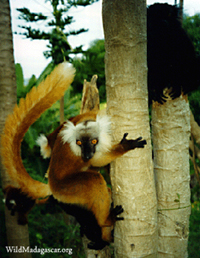 | Black lemur The black lemur lives in the tropical forests of northern Madagascar. Black lemurs are notable for the differences between the sexes. Males are black while females have reddish-brown fur with a black and white face. Black lemurs feed on fruit, flowers, and young leaves. | |
 | Dwarf lemur Dwarf lemurs are small nocturnal lemurs that feed on fruit, flowers, young leaves and insects. They are found throughout Madagascar. | |
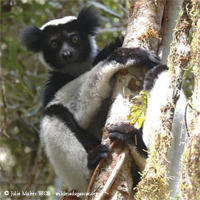 | Indri The indri is the largest living lemur. Black and white in color, the indri is famous for its eerie wail that sounds a bit like the song of a humpback whale. The indri feeds on fruit and leaves in the canopy of the rainforests of eastern Madagascar. Today the indri is endangered due to habitat loss. MORE | Hear the indri's song | |
 | Lepilemur, Sportive or Weasel lemur Lepilemurs are nocturnal lemurs that are easily spotted during daylight hours as they rest in tree hollows. Lepilemurs, which are neither weasel-like nor sportive, feed on leaves and are quite vocal at night. In 2005 the discovery of two new species of Lepilemur was announced. MORE | |
 | Mouse lemur Mouse lemurs are tiny primates found widely in Madagascar. Nocturnal and feeding on insects, small vertebrates, fruit, and flowers, mouse lemurs are known for their chirping vocalizations and frenetic activity. The pygmy mouse lemur (Microcebus myoxinus) may be the world's smallest primate. MORE | |
 | Red-fronted brown lemur The red-fronted brown lemur is widely distributed in the dry deciduous forests of western Madagascar, where it feeds on flowers, leaves, seed pods, fruit, insects, and bark. MORE | |
 | Red-ruffed lemur The red-ruffed lemur is found in the rainforests of the Masoala peninsula in northeastern Madagascar. Red-ruffed lemurs live in groups and practice a form of communal parenting. Unlike most other lemurs, their young are not carried by females but left in a nest in the canopy while adults forage. MORE | |
 | Ring-tailed lemur The ring-tailed lemur is the best known of lemurs. Ringtails live in the dry forests of southern and western Madagascar where they feed on fruit, flowers, leaves, and bark. Ring-tailed lemurs are the most terrestrial of living lemur species and are found in female-dominated groups consisting of three to 20 animals. MORE | See ring-tailed lemurs in action | |
 | Verreaux's sifaka Sifakas are relatiely large lemurs found throughout Madagascar. Verreaux's sifaka lives in the dry forests of western and southern Madagascar, where it feeds on leaves, fruit, and flowers. Sifakas are quite vocal with a variety of calls. Sifakas are sometimes known as "dancing lemurs" for their mode of locomotion when they cross open ground: sifakas do not move about on all fours—instead they sashay on their hind legs while holding their arms aloft MORE | See the "sifaka dance" | |
 | Black-and-white ruffed lemur The black-and-white ruffed lemur lives in the eastern rainforests of Madagascar including the island of Nosy Mangabe. Like the closely related red ruffed lemur of the Masoala peninsula, black-and-white ruffed lemurs are highly territorial and practice communal care for infants, which are kept in nests rather than being carried on the backs or stomachs of their mothers. Black-and-white ruffed lemurs are widely hunted over their range. They also suffer from habitat loss. MORE | |
 | Flying fox Flying foxes are bats that feed on fruit. | |
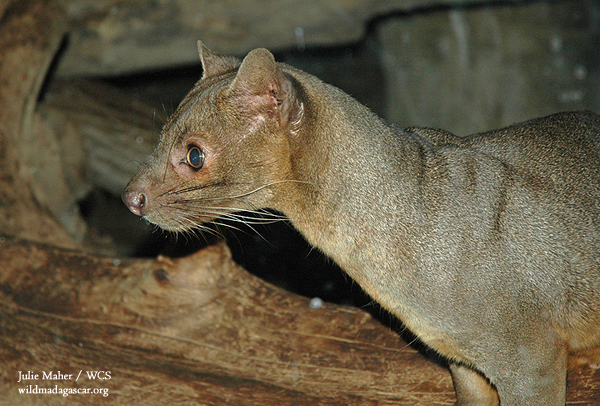 | Fossa The fossa is a carnivore that is related to a mongoose and looks like a cross between a puma and a dog. Fossas are nocturnal creatures that hunt almost any animal including insects, reptiles, rodents and lemurs. They also prey on chickens in and around Malagasy villages and are hunted by local people as vermin. Fossa are active both in trees and on the ground and are excellent climbers using their long tails for balance and retractable claws for climbing straight up and down tree trunks. MORE | |
 | Fanaloka The Fanaloka is a carnivore found in the rainforests of eastern Madagascar. MORE | |
 | Narrow-striped mongoose The narrow-striped mongoose is a small carnivore found in western Madagascar. MORE | |
 | Tenrec Tenrecs are unusual insectivores that have radiated into ecological niches filled in other lands by hedgehogs, mice, shrews, opossums, and even otters. While a few species of tenrec are found in central Africa, they are most diverse in Madagascar, which has around 30 species. MORE | |
 | Blue coua Madagascar has "only" 258 bird species, although 115 of these are endemic (with 36 endemic genera), Madagascar has more unique genera than any other African country. MORE | |
 | Brookesia chameleon Brookesia chameleons are some of the world's smallest reptiles—one species reaches a maximum length of just over an inch (30 mm). Also known as stumped-tailed or leaf chameleons, these diminutive creatures are found in the leaf litter of rainforests and dry deciduous forests in much of Madagascar. Brookesia feed on small insects and rely on their cyptic coloration to evade predators. When disturbed, these chameleons will play dead in an effort to resemble a fallen leaf. MORE | |
 | Chameleon Madagascar is home to about half the world's 150 or so species of chameleons, which are small to mid-size reptiles that are famous for their ability to dramatically change colors. Contrary to popular belief, a chameleon typically does not change colors to match its surroundings. Instead color is usually used to convey emotions, defend territories, and communicate with mates. MORE | |
 | Day gecko Unlike most geckos, which are nocturnal, Phelsuma day geckos are diurnal lizards. Day geckos are found in Madagascar and nearby islands including the Comoros, Andamans, and Seychelles. They are often brightly colored and use body positioning and movement for territorial displays. Day geckos feed mostly on insects, but also occasionally on fruit and flower nectar. MORE | |
 | Uroplatus geckos Leaf-tailed or Uroplatus geckos rely on cryptic coloration as they sleep with their heads downward, flattened against tree trunks and adjusting their body coloration to their surroundings. Inactive during the day, Uroplatus geckos only move when disturbed. They respond to prodding with an impressive display of a brightly colored gaping mouth and an erect tail. At night they hunt insects. MORE | |
 | Nile crocodile Crocodilus niloticus, the Nile crocodile, is found in freshwater habitats in Madagascar. This species was once widely abundant and greatly feared in the country but years of hunting for its skins has made it a threatened species. Crocodiles are found in the caves of Ankarana special reserve. National Geographic led an expedition to learn about this unique behavior. | |
 | Spear-nosed snake Madagascar is home to more than 80 species of snakes, none of which are overtly dangerous to humans. The island has no adders, cobras, mambas, pythons, or vipers—only boas and colubrids. MORE | |
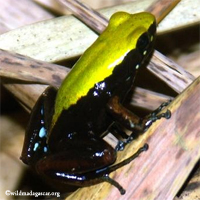 | Mantella frog Madagascar is thought to have more than 300 species of frogs, 99 percent of which are endemic. Frogs are the only amphibians found in Madagascar—there are no toads, salamanders, or newts. Mantella are among the most popular of Malagasy frogs in the pet trade. These strikingly beautiful frogs fill a similar ecological niche to the poison dart frogs of South America in that both use bright colors to advertise their toxic skin secretions to predators. MORE | |
 | Tomato frog The Tomato frog (Dyscophus antongili) can release a sticky glue-like secretion that protects it against colubrid snakes, cats, and dogs. The secreted substance can produce an allergic reaction in humans as well. | |
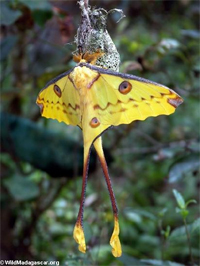 | Comet Moth The Comet Moth (also known as the Madagascan Moon Moth) is known for its huge tail—up to 8 inches (20cm) in length. | |
 | Pill Millipede Millipedes are common in the forests of Madagascar. These elongated arthropods have two pairs of legs for each one of their 20 to 100 or more body segments. They are herbivorous, eating decaying leaves and other dead plant matter. Pill millipedes superficially resemble pill bugs for their ability to roll into a tight ball when confronted with danger. | |
 | Flatid Leaf Bugs The adult form of flatid leaf bugs. When young (in their "nymph" form), these insects resemble lace decorations. |
Friday, January 19, 2007
The Kolam Tradition

A tradition of figure-drawing in southern India expresses mathematical ideas and has attracted the attention of computer science
The women of Tamil Nadu in southeastern India traditionally cover their thresholds every morning with elaborate designs drawn with rice powder. Girls learn the ritual from their mothers and other female relatives, and kolam skills are considered a mark of grace, dexterity, discipline and concentration. Drawing the kolam figures is an important part of the Tamil Nadu culture and landscape. But with their orderly and often highly symmetrical designs, which frequently group into families, kolams are also expressive of mathematical ideas. In the last few decades, kolam figures have attracted the attention of computer scientists interested in describing images with picture languages. Different picture languages have been developed to describe different kolam families.
http://www.americanscientist.org/template/AssetDetail/assetid/14424
Friday, November 24, 2006
What is JoVE?
What is JoVE?
JoVE [Journal of Visualized Experiments] is an online research journal for publishing visualized (video-based) biological experiments.
http://www.myjove.com/Wednesday, August 16, 2006
Robin Cook's 'Abduction'
I finished off with Robin Cook's Abduction. This scifi novel is about 'Interterrens' who are considered to be 'first generation humans', abduct humans or 'second generation humans'. The them of the story is that there originated humans [first generation] and they where sophisticated peace loving and civilized in the early history of the Earth, which we hardly know about. There was a period in earth's history called 'Dark Age', where earth faced catastrophic events and all the life forms vanished form its faced. This event was predicted by scientist of first generation humans and they searched for an alternate home. They couldn't find one so they have to go under sea a layer under sea which is between earth's crust and mantle called Mohorovičić discontinuity, usually referred to as the Moho. After the Dark Age is over life originated again on earth and started off with a new pace. Then comes second generation humans after millions of years. All these time first generation humans or interterrens where watching us or rather the changes on earth. They cant come back to earth's surface as they are not exposed to the viruses or bacteria present here.
The story starts with a group of geographic exploration done by a team of 'Banthic Marine vessel'. With the help of a submersible they goes to explore the sea mount and they eventually sucked inside the Interterra. They where decontaminated and send to the underworld city. The story is about their [second generation human's] struggle to go back to earth surface.
The novel touches the areas of geology, biotechnology and time travel with a perfect blend of fiction. Mr.Cook has portraited Interterra as an Utopian netherworld, with sophisticated technology. The people there are immortal, as death is just a process of getting rid of their old bodies and their spirit or essence is refilled into their new bodies, with cloning techniques. The work in Intertera is done by Worker clones which are semi hominids...ie.. half machine half human.
The whole interterra is build by the concept of utopian socialism. There are plenty of every thing, which means there is no competition among the interterrans. Robin cook has intruded the socialist thoughts in the light of Scifi and he admits that only on a higly cultured society or humans can maintain this socialism. One more fact is that there is no religion. Its true in a sense that if you can clone your mind and body what is the need of a god. How superior those Interterrans are.There is one draw back of this society, ie nothing but the never ending monotony. 'Abduction' gives a thought, whether this socialist thoughts can be introduced into our existing society. Well firstly we need so much sophisticated technologies; then a liberal mind to make such a civilized society and equal economic distribution or no distribution and more importantly NO RELIGION [U know what happens to USSR]. As in 'interterra' all things belongs to every one .... even partners and sex.
I really enjoyed the reading and Its thought provoking.....
The story starts with a group of geographic exploration done by a team of 'Banthic Marine vessel'. With the help of a submersible they goes to explore the sea mount and they eventually sucked inside the Interterra. They where decontaminated and send to the underworld city. The story is about their [second generation human's] struggle to go back to earth surface.
The novel touches the areas of geology, biotechnology and time travel with a perfect blend of fiction. Mr.Cook has portraited Interterra as an Utopian netherworld, with sophisticated technology. The people there are immortal, as death is just a process of getting rid of their old bodies and their spirit or essence is refilled into their new bodies, with cloning techniques. The work in Intertera is done by Worker clones which are semi hominids...ie.. half machine half human.
The whole interterra is build by the concept of utopian socialism. There are plenty of every thing, which means there is no competition among the interterrans. Robin cook has intruded the socialist thoughts in the light of Scifi and he admits that only on a higly cultured society or humans can maintain this socialism. One more fact is that there is no religion. Its true in a sense that if you can clone your mind and body what is the need of a god. How superior those Interterrans are.There is one draw back of this society, ie nothing but the never ending monotony. 'Abduction' gives a thought, whether this socialist thoughts can be introduced into our existing society. Well firstly we need so much sophisticated technologies; then a liberal mind to make such a civilized society and equal economic distribution or no distribution and more importantly NO RELIGION [U know what happens to USSR]. As in 'interterra' all things belongs to every one .... even partners and sex.
I really enjoyed the reading and Its thought provoking.....
Tuesday, August 01, 2006
Wednesday, July 05, 2006
Good For You
Hawaii Business Magazine
Good For You
With so many food choices available, Hawaii Business looks at what goes into what we eat
By Keala Francis
photo: istockphoto
“When I ask students where their food comes from, they say, ‘The supermarket,’” says Carol Okada, plant quarantine branch manager for the Hawaii Department of Agriculture.
These students aren’t alone. Even with raw sewage spills, controversy over taro patents and threats of an avian flu pandemic, studies show that local consumers are almost completely unaware of how their food is grown and what goes into it.
Most Hawaii consumers, like their national counterparts, don’t know that more than 70 percent of processed foods in the U.S. market contain at least one genetically modified (GM) ingredient. Most have never heard of GM foods, even though Hawaii’s papaya industry is more than 50 percent GM and the University of Hawaii’s patents on genetic modifications to taro are a source of deep controversy. In addition, many countries have banned GM foods.
Organic consumers and farmers, whose crops by definition cannot have any genetically modified organisms (GMOs), are the most vocal opponents of biotechnology, the industry behind GM. However, both organics and biotechnology are decades-old agricultural production methods, each with a distinct philosophy, history and industrial scale.
TWEAKING CONVENTION
Modern biotechnology began in the early 1970s, with the discovery of recombinant deoxyribonucleic acid (rDNA) technology, and was designed to introduce beneficial genetic traits, such as pesticide resistance, and add nutritional value.
rDNA technology enables scientists to insert a genetic trait directly into a plant’s DNA and, over the past decade, most biotechnology applications have attempted to introduce traits that reduce pesticide use, increase herbicide resistance and increase crop yields to solve supply problems. Most GM foods, such as corn and soybeans, are grown on an industrial scale.
But GM food sales are hard to quantify, because, unlike organic foods, they are not labeled. A 2005 national consumer study commissioned by the Pew Initiative on Food and Biotechnology found only 41 percent of consumers nationwide are aware of GM foods. Hawaii consumer awareness is at 42 percent, according to preliminary data from a recent statewide survey of 550 consumers conducted by Sabry Shehata, professor of agricultural economics at the University of Hawaii.
Most consumers, even if they are aware, do not understand biotechnology. Although the idea of using genes to cultivate certain traits in a plant began with conventional breeding in the 1860s, with Gregor Mendel’s laws of heredity, biotechnology’s method is very different. The final product, supporters argue, is the same.
According to the U.S. Food and Drug Administration (FDA), GM crops are considered to have “substantial equivalence” to conventional crops. There is no reason then, biotechnology supporters argue, to distinguish GM foods from conventional foods.
INPUTS AND OUTPUTS
Organic foods distinguish themselves from conventional foods mainly through production methods, which are designed on principle to protect the environment, soil and biodiversity. Organic standards prohibit the use of irradiation, sewage sludge and genetic modification.
The organic movement began in the 1920s, with the concept of interrelationship among plants, soil, livestock and people, and grew in reaction to industrialized farming’s use of pesticides in the 1940s.
Based on growing consumer and producer demands for standards, certification programs were created, but it wasn’t until 2002 that the U.S. Department of Agriculture (USDA) implemented national organic standards on organic production and processing to strictly regulate the use of chemicals and other agricultural inputs.
Organic farmers manage pests and other growing problems through various methods, such as: biological, using beneficial pests and parasites; cultural, choosing strategic planting and harvesting dates; mechanical, working with the native soil; and chemical, using organically acceptable pesticides, as defined by the USDA.
Awareness of Genetically Modified Foods
source: the mellman group inc. and public opinion strategies (10/05)
Organic foods have always been a niche market, only recently moving onto mainstream shelves in local supermarkets, Wal-Mart and Costco. Organic food sales have grown at a rapid 20 percent per year nationwide over the past decade, but the category still accounted for less than 2 percent of total food sales in 2003.
Most organic farmers in the U.S., and all local organic farmers, are extremely small producers. Currently, demand for organic foods outweighs supply — local organic farmers say they could sell five to 10 times their current production — but organic production accounted for only .001 percent of Hawaii’s overall market value for agricultural products in 2002, according to USDA data.
Hawaii already imports 80 percent of all food, and the percentage of organic product imports is potentially even higher. Down to Earth CEO Mark Fergusson said the local natural foods chain imports at least 80 percent of its organic produce from the Mainland. “We have seen a significant increase in demand since the 1980s, but the supply side is very limited,” he said.
With Whole Foods Market, a national natural foods chain, scheduled to enter the Hawaii market in 2008, local organic supply will grow even tighter — and prices will go up.
Hawaii consumers are long inured to high prices and nationwide consumers are used to paying a premium for organic foods. But even with labeling, they are not necessarily educated on what they are buying. “A lot of people don’t understand organics,” Fergusson said. “Once we start talking about attributes, such as chemical free, people become more interested.”
Organic foods are not risk free, though. There are risks of pathogen contamination from manure-based fertilizers and fungal diseases, according to Carl Evensen, chair and extension specialist in the Department of Natural Resources and Environmental Management at the College of Tropical Agriculture and Human Resources (CTAHR) at the University of Hawaii – Manoa.
Farmers’ decisions are based on economics, necessity and beliefs. Organic farmers are more concerned about biotechnology than consumers, because they worry a GM crop will “contaminate” (or cross-pollinate) their organic crop, which by definition must be GMO free.
However, many conventional farmers support biotechnology as a growing method. Richard Ha, owner of Hamakua Springs on the Big Island, would like to see the development of a GM banana to fight the banana bunchy-top virus (BBTV), which conventional means have not successfully prevented.
“At some point, we have to decide whether we live with BBTV or not, but we’ll also have to live with a real low supply of bananas,” he says.
Ha is experimenting with other growing methods, but has been unable to make organics work economically.
“With our tomatoes, we deliberately chose hydroponic [a non-soil growing method] over organic to reduce pesticide use,” he says. “With organic, you cannot grow on a large enough scale to make a dent in the local supply of produce. If we felt we could do organic, we would do it. We’re trying, but it’s an economic thing. It can’t just be a philosophy.”
Susan Matsushima, president of Alluvion, a local wholesale nursery, has been involved in agricultural issues in the state for years. She is pro-GMO as a way to help farmers remain viable. “In order to feed the masses, I would rather have a process more scientific, so we don’t need pesticides,” Matsushima says. “The most important thing is we need to do things safely.”
CONSUMERS WANT LABELING
Both the Pew study and Shehata’s preliminary findings show consumers overwhelmingly favor labeling of biotechnology products, with support by 90 percent of consumers nationwide and 80 percent statewide (more than 90 percent on Kauai and Maui).
“The most important finding in my study is labeling,” said Shehata. “Consumers want labeling and want to understand why the biotechnology industry is fighting against labeling. Their question is: ‘Why are they fighting it if the technology is kosher?’”
Many anti-GMO organizations believe biotechnology companies are trying to put their products on the market surreptitiously. However, the labeling issue is more complex.
Because the FDA considers GM products to have “substantial equivalence,” the agency only requires labeling if the GMO substantially changes the nutritional content or introduces a new allergen. The FDA also considers GM foods on the market to be safe, and the Pew study shows the majority of Americans trust the FDA. Biotechnology companies undergo a voluntary consultative process, in which the company submits data to petition that a GM crop no longer requires regulatory oversight and states that it is free from risk under current standards.
Global Commercial GM Crops - Traits
source: World Health Organization
Multiple scientific groups, such as the American Medical Association, also support the safety of biotechnology. The World Health Organization (WHO) released an international study in 2005, stating that GM foods had undergone risk assessments and were unlikely to present health risks any more than conventional foods. The report did recommend ongoing testing on long-term effects and assessment of ethical and religious issues.
The biotechnology industry has actively fought against mandatory labeling, including a $5.5 million campaign to help defeat a proposed labeling law in Oregon in 2002. Biotechnology proponents argue that labeling is proscribed for food safety reasons, such as quality, nutrition and health hazards, not for production methods. However, organic certification requirements and labeling standards are predominantly focused on production methods, not safety.
Studies show labeling would increase costs by up to 10 percent. Interestingly, consumer support for labeling dropped as prices rose. According to Shehata’s preliminary data, even though 73 percent of Hawaii consumers were willing to purchase GM foods, only 30 percent were willing to buy them if the cost was 10 percent higher.
In comparison, organic products command up to a 50 percent price premium and are the fastest growing agricultural category in the U.S.
Joseph Mendelson, legal director of the Center for Food Safety, a nonprofit public interest and environmental advocacy group, believes biotechnology companies have ignored consumer attitudes. “They are the only purveyor of a new technology that is not selling us on the innovation of that technology,” he said. “The only way it’s accepted is by consumers not knowing that it’s happening.”
Biotechnology representatives say they are trying to change that perception. The Hawaii Crop Improvement Association (HCIA), a local biotechnology trade organization, has an outreach and education group to help legislators and consumers better understand biotechnology. According to Paul Koehler, president of HCIA and the Hawaii business and communications affairs manager for the largest biotechnology company, Monsanto, HCIA’s outreach and education group, gives presentations to local community organizations, legislators and students. Monsanto also provides community tours of its Maui facilities based on consumer interest.
CONSUMERS SUPPORT RESEARCH AND RISK
Globally, governments and consumers continue to demand more transparency from the biotechnology industry. More than 22 countries plan to institute some form of mandatory labeling, and major countries, including those in the European Union, have banned many GM products, although those bans are currently under review. Some American companies, such as Frito Lay refuse to purchase GM products.
Even with the controversy surrounding biotechnology, the 2005 WHO report found that consumers did not demand “zero risk” from biotechnology products. The Pew study shows 65 percent of consumers favor research into GM foods, especially if the purpose is to enhance health and safety. More than 70 percent of consumers favor research into using biotechnology to reduce the use of pesticides. The preliminary Hawaii findings show local consumers are willing to purchase GM foods if the genetic modification reduces the use of pesticides (60 percent) or improves nutrition (65 percent).
Risk assessment also plays a large role in understanding the value of biotechnology. Ania Wieczorek, an assistant professor in biotechnology at CTAHR, notes that all agricultural products have risks.
“All crops we eat contain toxins, but the level of toxins is very low, based on the amount we consume,” Wieczorek says. “On one side, biotechnology crops show a lot of potential. On the other hand, they have a small risk of a negative impact. At what point do you decide what is acceptable? The consumer will have to decide.”
Food safety and the true benefits of biotechnology remain sticking points among proponents and foes. Biotechnology opponents fear weeds will acquire herbicide resistance and need even more chemical spraying. Worldwide, 72 percent of commercial GM crops have an herbicide-tolerant trait, according to the WHO report. That Monsanto, the top biotechnology company, is also one of the largest producers of herbicide has only increased opponents’ distrust.
Conflicting statistics confuse the issue further. HCIA cites lowered pesticide use, down by 380 million pounds globally from 1996 to 2004, as a key benefit to biotechnology. In contrast, a 2004 study by Charles M. Benbrook, a scientist and expert in pesticide regulatory law, reported pesticide use in the U.S. had increased 122 million pounds from 1996 to 2004.
However, in the end, it is consumers, informed or not, who will determine which foods get bought and eaten.
Shehata says, “When consumers are educated, they are the king.”
Hawaii’s Rainbow Connection
All commercial papayas grown in the U.S. are grown in Hawaii. More than 50 percent of them are genetically modified to resist the papaya ring virus, which devastated the local papaya industry in the early 1990s.
However, Japan, a major export market for Hawaiian papaya, does not accept genetically modified (GM) papayas. To solve the problem, local farmers adopted an “identity preservation protocol” to ensure papayas sold in the Japanese market did not contain genetically modified organisms (GMOs). The protocol essentially serves as a voluntary labeling standard, with strict certification processes and testing.
Loren Mochida, owner of Tropical Hawaiian Products on the Big Island, has farmed both conventional and GM papayas since 1998 and has only had to destroy two trees that tested “false positive” for GMOs. Using geographic isolation, with defined perimeters and berms to prevent cross-pollination between papaya trees, he actually surrounds his conventional papaya tree plantings with GM papaya plantings to reduce the chance of ring virus infecting his conventional crop.
Mochida says farming conventional papayas is difficult for economic reasons. “Growers are reluctant to plant Kapoho [conventional papaya], because they make more money with Rainbow [GM papaya], because with Rainbow they don’t lose trees and can keep the trees producing longer,” he says. “We are working with the Japanese government to allow Rainbow into their markets. I hope one of these days I can just plant transgenic [GM].”
In the past two years, the commodities branch of Hawaii’s Department of Agriculture has rejected “way less than 1 percent” of conventional papayas shipped to Japan, according to Darrel Kohara, acting Hawaii district supervisor for the Commodities Branch. “Our last rejection was over a year-and-a-half ago, and it was due to an applicant not following procedure,” he says.
However, commercial papayas are the only ones monitored by such a program. GM papayas are unlabeled in stores and home gardeners unknowingly using these seeds are planting GM papaya.
“Hawaii’s GM papayas are a real threat to organic papaya growers,” says Nancy Redfeather, a local organic farmer and GMO-free advocate. “Once a GM crop is introduced into a regional area, it’s only a matter of time until you can no longer grow the crop with the genetic certainty you had before.
—KF
Good For You
With so many food choices available, Hawaii Business looks at what goes into what we eat
By Keala Francis
photo: istockphoto
“When I ask students where their food comes from, they say, ‘The supermarket,’” says Carol Okada, plant quarantine branch manager for the Hawaii Department of Agriculture.
These students aren’t alone. Even with raw sewage spills, controversy over taro patents and threats of an avian flu pandemic, studies show that local consumers are almost completely unaware of how their food is grown and what goes into it.
Most Hawaii consumers, like their national counterparts, don’t know that more than 70 percent of processed foods in the U.S. market contain at least one genetically modified (GM) ingredient. Most have never heard of GM foods, even though Hawaii’s papaya industry is more than 50 percent GM and the University of Hawaii’s patents on genetic modifications to taro are a source of deep controversy. In addition, many countries have banned GM foods.
Organic consumers and farmers, whose crops by definition cannot have any genetically modified organisms (GMOs), are the most vocal opponents of biotechnology, the industry behind GM. However, both organics and biotechnology are decades-old agricultural production methods, each with a distinct philosophy, history and industrial scale.
TWEAKING CONVENTION
Modern biotechnology began in the early 1970s, with the discovery of recombinant deoxyribonucleic acid (rDNA) technology, and was designed to introduce beneficial genetic traits, such as pesticide resistance, and add nutritional value.
rDNA technology enables scientists to insert a genetic trait directly into a plant’s DNA and, over the past decade, most biotechnology applications have attempted to introduce traits that reduce pesticide use, increase herbicide resistance and increase crop yields to solve supply problems. Most GM foods, such as corn and soybeans, are grown on an industrial scale.
But GM food sales are hard to quantify, because, unlike organic foods, they are not labeled. A 2005 national consumer study commissioned by the Pew Initiative on Food and Biotechnology found only 41 percent of consumers nationwide are aware of GM foods. Hawaii consumer awareness is at 42 percent, according to preliminary data from a recent statewide survey of 550 consumers conducted by Sabry Shehata, professor of agricultural economics at the University of Hawaii.
Most consumers, even if they are aware, do not understand biotechnology. Although the idea of using genes to cultivate certain traits in a plant began with conventional breeding in the 1860s, with Gregor Mendel’s laws of heredity, biotechnology’s method is very different. The final product, supporters argue, is the same.
According to the U.S. Food and Drug Administration (FDA), GM crops are considered to have “substantial equivalence” to conventional crops. There is no reason then, biotechnology supporters argue, to distinguish GM foods from conventional foods.
INPUTS AND OUTPUTS
Organic foods distinguish themselves from conventional foods mainly through production methods, which are designed on principle to protect the environment, soil and biodiversity. Organic standards prohibit the use of irradiation, sewage sludge and genetic modification.
The organic movement began in the 1920s, with the concept of interrelationship among plants, soil, livestock and people, and grew in reaction to industrialized farming’s use of pesticides in the 1940s.
Based on growing consumer and producer demands for standards, certification programs were created, but it wasn’t until 2002 that the U.S. Department of Agriculture (USDA) implemented national organic standards on organic production and processing to strictly regulate the use of chemicals and other agricultural inputs.
Organic farmers manage pests and other growing problems through various methods, such as: biological, using beneficial pests and parasites; cultural, choosing strategic planting and harvesting dates; mechanical, working with the native soil; and chemical, using organically acceptable pesticides, as defined by the USDA.
Awareness of Genetically Modified Foods
source: the mellman group inc. and public opinion strategies (10/05)
Organic foods have always been a niche market, only recently moving onto mainstream shelves in local supermarkets, Wal-Mart and Costco. Organic food sales have grown at a rapid 20 percent per year nationwide over the past decade, but the category still accounted for less than 2 percent of total food sales in 2003.
Most organic farmers in the U.S., and all local organic farmers, are extremely small producers. Currently, demand for organic foods outweighs supply — local organic farmers say they could sell five to 10 times their current production — but organic production accounted for only .001 percent of Hawaii’s overall market value for agricultural products in 2002, according to USDA data.
Hawaii already imports 80 percent of all food, and the percentage of organic product imports is potentially even higher. Down to Earth CEO Mark Fergusson said the local natural foods chain imports at least 80 percent of its organic produce from the Mainland. “We have seen a significant increase in demand since the 1980s, but the supply side is very limited,” he said.
With Whole Foods Market, a national natural foods chain, scheduled to enter the Hawaii market in 2008, local organic supply will grow even tighter — and prices will go up.
Hawaii consumers are long inured to high prices and nationwide consumers are used to paying a premium for organic foods. But even with labeling, they are not necessarily educated on what they are buying. “A lot of people don’t understand organics,” Fergusson said. “Once we start talking about attributes, such as chemical free, people become more interested.”
Organic foods are not risk free, though. There are risks of pathogen contamination from manure-based fertilizers and fungal diseases, according to Carl Evensen, chair and extension specialist in the Department of Natural Resources and Environmental Management at the College of Tropical Agriculture and Human Resources (CTAHR) at the University of Hawaii – Manoa.
Farmers’ decisions are based on economics, necessity and beliefs. Organic farmers are more concerned about biotechnology than consumers, because they worry a GM crop will “contaminate” (or cross-pollinate) their organic crop, which by definition must be GMO free.
However, many conventional farmers support biotechnology as a growing method. Richard Ha, owner of Hamakua Springs on the Big Island, would like to see the development of a GM banana to fight the banana bunchy-top virus (BBTV), which conventional means have not successfully prevented.
“At some point, we have to decide whether we live with BBTV or not, but we’ll also have to live with a real low supply of bananas,” he says.
Ha is experimenting with other growing methods, but has been unable to make organics work economically.
“With our tomatoes, we deliberately chose hydroponic [a non-soil growing method] over organic to reduce pesticide use,” he says. “With organic, you cannot grow on a large enough scale to make a dent in the local supply of produce. If we felt we could do organic, we would do it. We’re trying, but it’s an economic thing. It can’t just be a philosophy.”
Susan Matsushima, president of Alluvion, a local wholesale nursery, has been involved in agricultural issues in the state for years. She is pro-GMO as a way to help farmers remain viable. “In order to feed the masses, I would rather have a process more scientific, so we don’t need pesticides,” Matsushima says. “The most important thing is we need to do things safely.”
CONSUMERS WANT LABELING
Both the Pew study and Shehata’s preliminary findings show consumers overwhelmingly favor labeling of biotechnology products, with support by 90 percent of consumers nationwide and 80 percent statewide (more than 90 percent on Kauai and Maui).
“The most important finding in my study is labeling,” said Shehata. “Consumers want labeling and want to understand why the biotechnology industry is fighting against labeling. Their question is: ‘Why are they fighting it if the technology is kosher?’”
Many anti-GMO organizations believe biotechnology companies are trying to put their products on the market surreptitiously. However, the labeling issue is more complex.
Because the FDA considers GM products to have “substantial equivalence,” the agency only requires labeling if the GMO substantially changes the nutritional content or introduces a new allergen. The FDA also considers GM foods on the market to be safe, and the Pew study shows the majority of Americans trust the FDA. Biotechnology companies undergo a voluntary consultative process, in which the company submits data to petition that a GM crop no longer requires regulatory oversight and states that it is free from risk under current standards.
Global Commercial GM Crops - Traits
source: World Health Organization
Multiple scientific groups, such as the American Medical Association, also support the safety of biotechnology. The World Health Organization (WHO) released an international study in 2005, stating that GM foods had undergone risk assessments and were unlikely to present health risks any more than conventional foods. The report did recommend ongoing testing on long-term effects and assessment of ethical and religious issues.
The biotechnology industry has actively fought against mandatory labeling, including a $5.5 million campaign to help defeat a proposed labeling law in Oregon in 2002. Biotechnology proponents argue that labeling is proscribed for food safety reasons, such as quality, nutrition and health hazards, not for production methods. However, organic certification requirements and labeling standards are predominantly focused on production methods, not safety.
Studies show labeling would increase costs by up to 10 percent. Interestingly, consumer support for labeling dropped as prices rose. According to Shehata’s preliminary data, even though 73 percent of Hawaii consumers were willing to purchase GM foods, only 30 percent were willing to buy them if the cost was 10 percent higher.
In comparison, organic products command up to a 50 percent price premium and are the fastest growing agricultural category in the U.S.
Joseph Mendelson, legal director of the Center for Food Safety, a nonprofit public interest and environmental advocacy group, believes biotechnology companies have ignored consumer attitudes. “They are the only purveyor of a new technology that is not selling us on the innovation of that technology,” he said. “The only way it’s accepted is by consumers not knowing that it’s happening.”
Biotechnology representatives say they are trying to change that perception. The Hawaii Crop Improvement Association (HCIA), a local biotechnology trade organization, has an outreach and education group to help legislators and consumers better understand biotechnology. According to Paul Koehler, president of HCIA and the Hawaii business and communications affairs manager for the largest biotechnology company, Monsanto, HCIA’s outreach and education group, gives presentations to local community organizations, legislators and students. Monsanto also provides community tours of its Maui facilities based on consumer interest.
CONSUMERS SUPPORT RESEARCH AND RISK
Globally, governments and consumers continue to demand more transparency from the biotechnology industry. More than 22 countries plan to institute some form of mandatory labeling, and major countries, including those in the European Union, have banned many GM products, although those bans are currently under review. Some American companies, such as Frito Lay refuse to purchase GM products.
Even with the controversy surrounding biotechnology, the 2005 WHO report found that consumers did not demand “zero risk” from biotechnology products. The Pew study shows 65 percent of consumers favor research into GM foods, especially if the purpose is to enhance health and safety. More than 70 percent of consumers favor research into using biotechnology to reduce the use of pesticides. The preliminary Hawaii findings show local consumers are willing to purchase GM foods if the genetic modification reduces the use of pesticides (60 percent) or improves nutrition (65 percent).
Risk assessment also plays a large role in understanding the value of biotechnology. Ania Wieczorek, an assistant professor in biotechnology at CTAHR, notes that all agricultural products have risks.
“All crops we eat contain toxins, but the level of toxins is very low, based on the amount we consume,” Wieczorek says. “On one side, biotechnology crops show a lot of potential. On the other hand, they have a small risk of a negative impact. At what point do you decide what is acceptable? The consumer will have to decide.”
Food safety and the true benefits of biotechnology remain sticking points among proponents and foes. Biotechnology opponents fear weeds will acquire herbicide resistance and need even more chemical spraying. Worldwide, 72 percent of commercial GM crops have an herbicide-tolerant trait, according to the WHO report. That Monsanto, the top biotechnology company, is also one of the largest producers of herbicide has only increased opponents’ distrust.
Conflicting statistics confuse the issue further. HCIA cites lowered pesticide use, down by 380 million pounds globally from 1996 to 2004, as a key benefit to biotechnology. In contrast, a 2004 study by Charles M. Benbrook, a scientist and expert in pesticide regulatory law, reported pesticide use in the U.S. had increased 122 million pounds from 1996 to 2004.
However, in the end, it is consumers, informed or not, who will determine which foods get bought and eaten.
Shehata says, “When consumers are educated, they are the king.”
Hawaii’s Rainbow Connection
All commercial papayas grown in the U.S. are grown in Hawaii. More than 50 percent of them are genetically modified to resist the papaya ring virus, which devastated the local papaya industry in the early 1990s.
However, Japan, a major export market for Hawaiian papaya, does not accept genetically modified (GM) papayas. To solve the problem, local farmers adopted an “identity preservation protocol” to ensure papayas sold in the Japanese market did not contain genetically modified organisms (GMOs). The protocol essentially serves as a voluntary labeling standard, with strict certification processes and testing.
Loren Mochida, owner of Tropical Hawaiian Products on the Big Island, has farmed both conventional and GM papayas since 1998 and has only had to destroy two trees that tested “false positive” for GMOs. Using geographic isolation, with defined perimeters and berms to prevent cross-pollination between papaya trees, he actually surrounds his conventional papaya tree plantings with GM papaya plantings to reduce the chance of ring virus infecting his conventional crop.
Mochida says farming conventional papayas is difficult for economic reasons. “Growers are reluctant to plant Kapoho [conventional papaya], because they make more money with Rainbow [GM papaya], because with Rainbow they don’t lose trees and can keep the trees producing longer,” he says. “We are working with the Japanese government to allow Rainbow into their markets. I hope one of these days I can just plant transgenic [GM].”
In the past two years, the commodities branch of Hawaii’s Department of Agriculture has rejected “way less than 1 percent” of conventional papayas shipped to Japan, according to Darrel Kohara, acting Hawaii district supervisor for the Commodities Branch. “Our last rejection was over a year-and-a-half ago, and it was due to an applicant not following procedure,” he says.
However, commercial papayas are the only ones monitored by such a program. GM papayas are unlabeled in stores and home gardeners unknowingly using these seeds are planting GM papaya.
“Hawaii’s GM papayas are a real threat to organic papaya growers,” says Nancy Redfeather, a local organic farmer and GMO-free advocate. “Once a GM crop is introduced into a regional area, it’s only a matter of time until you can no longer grow the crop with the genetic certainty you had before.
—KF
Saturday, June 24, 2006
Resistance Evolution to Bt Crops
Resistance Evolution to Bt Crops: Predispersal Mating of European Corn Borers
Over the past decade, the high-dose refuge (HDR) strategy, aimed at delaying the evolution of pest resistance to Bacillus thuringiensis (Bt) toxins produced by transgenic crops, became mandatory in the United States and is being discussed for Europe. However, precopulatory dispersal and the mating rate between resident and immigrant individuals, two features influencing the efficiency of this strategy, have seldom been quantified in pests targeted by these toxins. We combined mark-recapture and biogeochemical marking over three breeding seasons to quantify these features directly in natural populations of Ostrinia nubilalis, a major lepidopteran corn pest. At the local scale, resident females mated regardless of males having dispersed beforehand or not, as assumed in the HDR strategy. Accordingly, 0–67% of resident females mating before dispersal did so with resident males, this percentage depending on the local proportion of resident males (0% to 67.2%). However, resident males rarely mated with immigrant females (which mostly arrived mated), the fraction of females mating before dispersal was variable and sometimes substantial (4.8% to 56.8%), and there was no evidence for male premating dispersal being higher. Hence, O. nubilalis probably mates at a more restricted spatial scale than previously assumed, a feature that may decrease the efficiency of the HDR strategy under certain circumstances, depending for example on crop rotation practices.
Tuesday, June 20, 2006
Greenpeace wants probe into cattle death
http://www.thehindu.com/2006/06/14/stories/2006061422791500.htm
Greenpeace wants probe into cattle death

KILLING FIELDS?: Greenpeace activists dressed up as sheep and cows stage a protest outside the Krishi Bhavan in New Delhi on Tuesday to draw the Agriculture Ministry's attention to mysterious deaths of cattle in Warangal after grazing on Bt cotton fields. — Photo: V. Sudershan
Engineered risks The door has been opened for the entry of genetically modified plant varieties in India. The battle against GM varieties has begun too.
Bt cotton, again The Genetic Engineering Approval Committee approves a fourth Bt cotton variety for commercial cultivation even as crops raised earlier using other varieties have been disappointing.
Seeds of controversy The Genetic Engineering Approval Committee has attracted severe criticism by granting approval to six new Bt cotton hybrids and extending the approval for seeds already under cultivation.
Greenpeace wants probe into cattle death
| About 1,600 head of cattle died in Andhra Pradesh's Warangal district after they grazed on Bt cotton fields |
KILLING FIELDS?: Greenpeace activists dressed up as sheep and cows stage a protest outside the Krishi Bhavan in New Delhi on Tuesday to draw the Agriculture Ministry's attention to mysterious deaths of cattle in Warangal after grazing on Bt cotton fields. — Photo: V. Sudershan
NEW DELHI: Greenpeace activists on Tuesday urged Agriculture Minister Sharad Pawar to order a probe into the "inexplicable" death of 1,600 head of cattle in Andhra Pradesh's Warangal district after they grazed on Bt cotton fields.
Greenpeace demanded that the Minister withdraw all permissions for commercial release of the existing GE crops until the probe was completed.
The activists, dressed as cows and sheep and carrying a banner asking, ``Did GM Crops Kill Us?'' wanted to submit a memorandum to Mr. Pawar, who was not available.
Placards depicting upturned cows and sheep with the question, ``Can GM crops kill?'' were laid out outside the Ministry office.
Greenpeace genetic engineering campaigner Rajesh Krishnan said: "The impact of GM technology on human health and biodiversity remains unpredictable, untested and irreversible. Despite this, the government is on the verge of approving large-scale field trials of GM brinjal [eggplant], the first GM food crop in India.
"Indians will be the first people in the world to eat GM brinjal. It's vital that the Agriculture Ministry first address the question raised by the cows and sheep today ``Can GM Foods kill?'' — UNI
© Copyright 2000 - 2006 The Hindu
Story Till Now:-Engineered risks The door has been opened for the entry of genetically modified plant varieties in India. The battle against GM varieties has begun too.
Bt cotton, again The Genetic Engineering Approval Committee approves a fourth Bt cotton variety for commercial cultivation even as crops raised earlier using other varieties have been disappointing.Seeds of controversy The Genetic Engineering Approval Committee has attracted severe criticism by granting approval to six new Bt cotton hybrids and extending the approval for seeds already under cultivation.
Monday, June 12, 2006
Thursday, June 08, 2006
PlanetHazard
PlanetHazard
Learn about the unknown hazards around you - the toxins you may be breathing. PlanetHazard uses information from the EPA to map over 86,000 companies throughout the United States that emit hazardous air pollutants.
PlanetHazard has mapped over 86,000 companies throughout the United States that emit hazardous air pollutants and criteria air pollutants. We have done this so that you can learn what companies are releasing into the air in your area. You may search this site nationally or by state, county, city and/or company. All pollutant data used on this site is from the Environmental Protection Agency National Emission Inventory Database and is current as of the most recent release, 2002. (This is preliminary data - the last official release was in 1999.)
Learn about the unknown hazards around you - the toxins you may be breathing. PlanetHazard uses information from the EPA to map over 86,000 companies throughout the United States that emit hazardous air pollutants.
PlanetHazard has mapped over 86,000 companies throughout the United States that emit hazardous air pollutants and criteria air pollutants. We have done this so that you can learn what companies are releasing into the air in your area. You may search this site nationally or by state, county, city and/or company. All pollutant data used on this site is from the Environmental Protection Agency National Emission Inventory Database and is current as of the most recent release, 2002. (This is preliminary data - the last official release was in 1999.)
No consensus yet on safety of GM foods
No consensus yet on safety of GM foods: "IN HER reply to a letter about the labelling of genetically modified (GM) foods, Ms Airani Ramli of the Genetic Modification Advisory Committee stated that 'the lack of international consensus refers to labelling of GM foods and not safety of GM foods' (ST, June 5).
She seems to suggest that there is consensus on the safety of GM foods. This is not so. There is continuing debate about the safety of GM foods. A number of scientists continue to express concern.
Ms Ramli herself states that 'so far, there has been no conclusive scientific evidence that GM foods now in the market are unsafe'.
'No conclusive evidence' means that, either way, scientists do not know for sure. Scientists do not know that GM foods are definitely unsafe; neither do they know that GM foods are definitely safe.
Moreover, Ms Ramli's discussion about the difficulties of detection is largely irrelevant.
Firstly, is she saying that if a criminal goes into hiding and becomes hard to detect, then it is not practical to seek him out and to inform the public about him?
Secondly, when certain food products are already known to contain GM material (equivalent to a person who is already known to be a criminal), there is no need for detection. In this case, why can't consumers be informed so that they can make their own choices?
As a nation, we are not afraid to be among the world leaders in taking bold measures, such as banning chewing gum, curbing smoking in public places and imposing the death penalty on drug traffickers.
But when it comes to labelling GM foods - as well as labelling foods that contain trans fats, which are now "
She seems to suggest that there is consensus on the safety of GM foods. This is not so. There is continuing debate about the safety of GM foods. A number of scientists continue to express concern.
Ms Ramli herself states that 'so far, there has been no conclusive scientific evidence that GM foods now in the market are unsafe'.
'No conclusive evidence' means that, either way, scientists do not know for sure. Scientists do not know that GM foods are definitely unsafe; neither do they know that GM foods are definitely safe.
Moreover, Ms Ramli's discussion about the difficulties of detection is largely irrelevant.
Firstly, is she saying that if a criminal goes into hiding and becomes hard to detect, then it is not practical to seek him out and to inform the public about him?
Secondly, when certain food products are already known to contain GM material (equivalent to a person who is already known to be a criminal), there is no need for detection. In this case, why can't consumers be informed so that they can make their own choices?
As a nation, we are not afraid to be among the world leaders in taking bold measures, such as banning chewing gum, curbing smoking in public places and imposing the death penalty on drug traffickers.
But when it comes to labelling GM foods - as well as labelling foods that contain trans fats, which are now "
Agenzia Giornalistica Italia - News In English
Agenzia Giornalistica Italia - News In English
MADE IN ITALY: POLITI(CIA),GM FOODS DON'T HELP OUR AGRICULTURE(AGI) - Rome, 10 May - GM foods do not help our agriculture, said Giuseppe Politi, national president of the CIA - the Confederation of Italian Farmers - while attending a round table meeting today in Rome as part of the conference promoted by the Council of Genetic Rights on the theme "Corn or grain: put GM to the government test". Politi recalled CIA's task of "focussing its action on the foundations that we cannot give up: quality production, that is a differentiated offer, with a high content of traditions and service, food safety and precaution principles, that is respect of the rules and of principles of public health, information and traceability; certainties for farmers, that is rules for the coexistence and system of checks, because they are made responsible for programming cultivation rules; protector of biodiversity and of the environment, that is recuperation and safeguarding of the traditional varieties that risk, due to difficulties of production and market, disappearing from cultivation organisation, innovation of productive techniques directed, amongst other things, at a more rational use of chemistry, research and diffusion of innovations".
MADE IN ITALY: POLITI(CIA),GM FOODS DON'T HELP OUR AGRICULTURE(AGI) - Rome, 10 May - GM foods do not help our agriculture, said Giuseppe Politi, national president of the CIA - the Confederation of Italian Farmers - while attending a round table meeting today in Rome as part of the conference promoted by the Council of Genetic Rights on the theme "Corn or grain: put GM to the government test". Politi recalled CIA's task of "focussing its action on the foundations that we cannot give up: quality production, that is a differentiated offer, with a high content of traditions and service, food safety and precaution principles, that is respect of the rules and of principles of public health, information and traceability; certainties for farmers, that is rules for the coexistence and system of checks, because they are made responsible for programming cultivation rules; protector of biodiversity and of the environment, that is recuperation and safeguarding of the traditional varieties that risk, due to difficulties of production and market, disappearing from cultivation organisation, innovation of productive techniques directed, amongst other things, at a more rational use of chemistry, research and diffusion of innovations".
Truth About Trade & Technology - Science Academies support GM-foods
Truth About Trade & Technology - Science Academies support GM-foods
Science Academies support GM-foods
by: Norbert Lossau
Berlin – During last weekend’s international meeting of the Science Academy in Berlin, twelve leading researchers in the field of green genetic technology worked on a manifesto which aims to clarify the significance of this technology. Scientist from Germany, China, South Africa, India, France, Egypt, Switzerland and the USA unanimously declared that transgenic food is at least as safe as other food. Genetically modified plants pose no danger to the environment and they don’t conflict with so-called bio-agriculture.Professor Klaus Ammann of the University of Berne accused Greenpeace of spreading “lies“ in this respect. Professor Walter Heldt of the University of Goettingen and chairman of the Academic Union Commission for Green Genetic Technology emphatically called for an objective instead of an ideological discussion about green genetic technology.This manifesto, compiled in Berlin by the so-called Interacademy Panel, will be submitted to all science academies around the World for ratification. It is probable that a majority of the academies will support the paper, which could then be presented to the public, in December.
Science Academies support GM-foods
by: Norbert Lossau
Berlin – During last weekend’s international meeting of the Science Academy in Berlin, twelve leading researchers in the field of green genetic technology worked on a manifesto which aims to clarify the significance of this technology. Scientist from Germany, China, South Africa, India, France, Egypt, Switzerland and the USA unanimously declared that transgenic food is at least as safe as other food. Genetically modified plants pose no danger to the environment and they don’t conflict with so-called bio-agriculture.Professor Klaus Ammann of the University of Berne accused Greenpeace of spreading “lies“ in this respect. Professor Walter Heldt of the University of Goettingen and chairman of the Academic Union Commission for Green Genetic Technology emphatically called for an objective instead of an ideological discussion about green genetic technology.This manifesto, compiled in Berlin by the so-called Interacademy Panel, will be submitted to all science academies around the World for ratification. It is probable that a majority of the academies will support the paper, which could then be presented to the public, in December.
Monday, June 05, 2006
India News - India may take lead in Bt brinjal trials
India News - India may take lead in Bt brinjal trials:
"New Delhi - India could lead the region in field trials of genetically modified brinjal this year if the genetic engineering approval committee (GEAC) of the environment and forests ministry gives its nod. Some genetically modified (GM) versions of crops like mustard, potato, tomato are approaching the stage of large-scale field trials to test their suitability for commercial cultivation, according to M.K. Bhan, secretary department of biotechnology (DBT).
‘Work on transgenic food crops is going on well. Brinjal, mustard and potato, are among transgenic crops awaiting permission for large-scale field trials,’ Bhan told IANS.
‘Nothing is going like brinjal, in which the work has advanced considerably. The bio-safety package has been completed and it may enter large-scale field trial soon,’ the official added.
‘Permission has been sought for large-scale trials and it may be taken up by GEAC at the next meeting in mid-June,’ the official said.
‘The large scale field trials may take one to two years. If approved for commercial cultivation after that, India will be the first country in the region to be producing Bt brinjal,’ the official added.
Widely cultivated and consumed in the region, brinjal or eggplant requires extensive use of pesticides next only to cotton. With the Bt gene to provide protection against pests like shoot and fruit borer and helicoverpa, there are eight hybrid varieties of brinjal of different shapes and colours grown in different parts of the country that are to be taken up for field trials.
While the Bt gene used in brinjal is the same as that used in Bt cotton, more extensive tests are being carried out as this time it involves a food crop.
‘Bt brinjal was tested for toxicity study with goats, cattle, fish, poultry, rat, mice and rabbit. The reports show adverse impact on health. All the data has been generated in public funded institutions,’ a DBT official informed.
‘The varieties being developed are for domestic consumption. Under the Indo-US collaboration programme the Cornell University is piloting a project - Agriculture Biotechnology Supportive Programme phase II - under which this technology will be transferred to Bangladesh and the Philippines,’ the official said.
On the apprehensions of the environmentalists, Bhan assured: ‘We want to go to the market with transgenics but will never compromise with bio-safety.’
While issues of efficacy of transgenic gene against pests and bio-safety will be addressed during large-scale field trial, for the consumers the proposed legislation on food labelling is expected to provide a safeguard, the official stated.
Transgenic mustard and potato may take another four to five years before reaching commercial production stage.
The effort in the case of these two food crops is to raise the quality of crop to yield more oil in case of mustard and for better nutrition quality in potato. The GM mustard developed by the National Research Centre for Rapeseed and Mustard has barnase-barstar genes incorporated for increasing oil content. Delhi University experts are conducting the trials of the GM mustard, which faced resistance some years back on question of bio-safety and health issues.
The question now being examined is whether transgenic mustard would indeed yield more oil and whether it would be in tandem with human and environmental health.
Asish Dutta of National Centre for Plant Genome Research has developed the transgenic potato by inserting genes from the amaranthus plant to improve the protein and lycine content. Having completed contained field trials at Shimla, the Potato Research Institute is now awaiting the nod to conduct large-scale field trial on its higher protein and lycine (one of the essential amino acids) potato variety"
"New Delhi - India could lead the region in field trials of genetically modified brinjal this year if the genetic engineering approval committee (GEAC) of the environment and forests ministry gives its nod. Some genetically modified (GM) versions of crops like mustard, potato, tomato are approaching the stage of large-scale field trials to test their suitability for commercial cultivation, according to M.K. Bhan, secretary department of biotechnology (DBT).
‘Work on transgenic food crops is going on well. Brinjal, mustard and potato, are among transgenic crops awaiting permission for large-scale field trials,’ Bhan told IANS.
‘Nothing is going like brinjal, in which the work has advanced considerably. The bio-safety package has been completed and it may enter large-scale field trial soon,’ the official added.
‘Permission has been sought for large-scale trials and it may be taken up by GEAC at the next meeting in mid-June,’ the official said.
‘The large scale field trials may take one to two years. If approved for commercial cultivation after that, India will be the first country in the region to be producing Bt brinjal,’ the official added.
Widely cultivated and consumed in the region, brinjal or eggplant requires extensive use of pesticides next only to cotton. With the Bt gene to provide protection against pests like shoot and fruit borer and helicoverpa, there are eight hybrid varieties of brinjal of different shapes and colours grown in different parts of the country that are to be taken up for field trials.
While the Bt gene used in brinjal is the same as that used in Bt cotton, more extensive tests are being carried out as this time it involves a food crop.
‘Bt brinjal was tested for toxicity study with goats, cattle, fish, poultry, rat, mice and rabbit. The reports show adverse impact on health. All the data has been generated in public funded institutions,’ a DBT official informed.
‘The varieties being developed are for domestic consumption. Under the Indo-US collaboration programme the Cornell University is piloting a project - Agriculture Biotechnology Supportive Programme phase II - under which this technology will be transferred to Bangladesh and the Philippines,’ the official said.
On the apprehensions of the environmentalists, Bhan assured: ‘We want to go to the market with transgenics but will never compromise with bio-safety.’
While issues of efficacy of transgenic gene against pests and bio-safety will be addressed during large-scale field trial, for the consumers the proposed legislation on food labelling is expected to provide a safeguard, the official stated.
Transgenic mustard and potato may take another four to five years before reaching commercial production stage.
The effort in the case of these two food crops is to raise the quality of crop to yield more oil in case of mustard and for better nutrition quality in potato. The GM mustard developed by the National Research Centre for Rapeseed and Mustard has barnase-barstar genes incorporated for increasing oil content. Delhi University experts are conducting the trials of the GM mustard, which faced resistance some years back on question of bio-safety and health issues.
The question now being examined is whether transgenic mustard would indeed yield more oil and whether it would be in tandem with human and environmental health.
Asish Dutta of National Centre for Plant Genome Research has developed the transgenic potato by inserting genes from the amaranthus plant to improve the protein and lycine content. Having completed contained field trials at Shimla, the Potato Research Institute is now awaiting the nod to conduct large-scale field trial on its higher protein and lycine (one of the essential amino acids) potato variety"
Subscribe to:
Posts (Atom)