10 MYTHS about Global WarmingDon't believe these commonly heard statements:
| |
15 Very Important Things to Do about Global Warming...from the individual to the national 1. Learn about it -- start with this Web site and see the References. 2. Sell the SUV and choose cleaner, more efficient vehicles. Reduce your driving: one gallon of gas burned creates 20 pounds of CO2. Fuel up on ethanol and biodiesel. 3. Use efficient appliances, replace light bulbs with low-voltage compact fluorescents, check your home insulation. Buy renewable energy, like wind and solar, from your power company. 5. Companies -- the one you work for and the ones you buy from -- can save lots of money and reduce global warming by taking similar steps toward energy efficiency. 6. Shop smart: Look for products made from recycled materials, created with renewable energy, and which help you save money and reduce pollution. 7. Use your vote and influence as a citizen to elect responsive leaders; help them organize the neighborhood and town for energy efficiency. 8. Suburban sprawl makes for lots of global warming pollution; plan for walkable communities, lots of trees, open spaces, and public transportation in and between cities. 10. Build new homes and buildings for efficiency and solar power. 11. Support sustainable farming and forestry, including new crops to make into ethanol and other biofuels. 12. Let the corporations who make our cars, fuels, goods and power know you want their products to be as ecological as possible. 13. At all government levels, develop an efficient energy policy, moving away from fossil fuels. 14. Export new energy technology that uses renewable energy sources to the rest of the world. 15. ....and start doing these things today. | 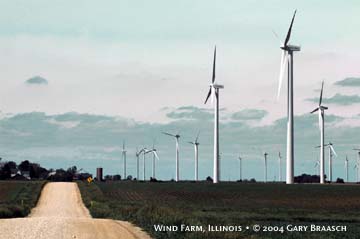 |
What can we do?
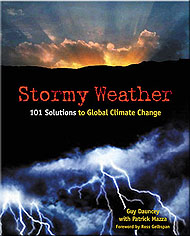
Each of can play a role in dealing with and slowing climate change. Each of us must. Right now, the best source for practical actions that can be adopted by individuals, groups, cities, businesses, and governments is the book Stormy Weather by Guy Dauncy and Patrick Mazza, published last year by New Society Publishers. The authors have a Web site which lists their recommendations, plus a great amount of climate information, at | |
Technologies to Combat Global Warming (first of a series)
Wind turbines are being installed worldwide at an increasing rate. Wind is the fastest growing energy technology in the world today. In recent years, wind capacity worldwide has more than doubled. The towers must be located to protect migrating birds and bats, and scenic landscapes -- which unfortunately early wind farms like Altamont California did not consider. This technology can increase the use and value of open farm and grazing land (see above in Illinois), and is also compatible with solar installations.
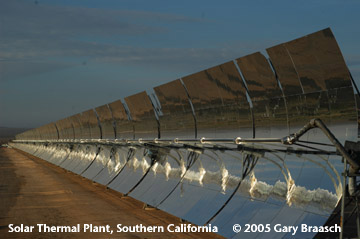
Another older solar electric generation system is the solar- thermal Kramer Junction array of five fields of 33 megawatts each in the Mojave desert. It has been on line since 1985 to produce electricity for the Southern California Edison power grid supplying the greater Los Angeles area. This technology uses parabolic mirrors to heat an oil which makes steam to run turbines.
| |
Photographs from the World View of Global Warming are available for license to publications needing science photography, environmental groups and agencies, and other uses. Stock photography and assignments available. Please contact info@worldviewofglobalwarming.org or Gary Braasch Photography (503) 699-6666. Use of photographs in any manner, in part or whole, without permission is prohibited by US copyright law. These photographs are registered with the US Copyright Office and are not in the Public Domain. | |
Gary Braasch, Photographer PO Box 1465 Portland, OR 97207 USA USA Phone: 503.699.6666 Cell: 503.860.1228 | |
Monday, June 04, 2007
10 myths abt global warming
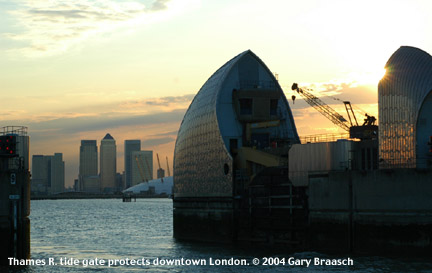 Increasingly nations and governments have been adopting technologies to deal with global warming. Some large installations are strictly defensive, like the Thames River Barrier protecting London, built beginning in 1982. At first it was used rarely, less than once a year, but British Science Advisor Sir David King says it is now closed against high tides 6 or 7 times a year.
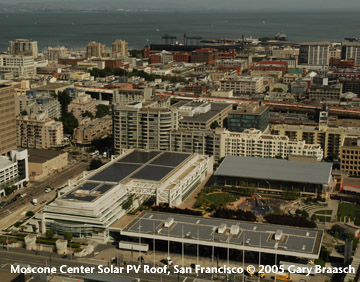 Solar is also growing and offers the flexibility of scale, from small panels for individual appliances in homes to huge acreages supplying cities and industries. The two forms of solar illustrated here are the photovoltaic panel used in the array on the roof of the Moscone Convention Center in San Francisco. This is the largest civic owned solar installation in the US. Its 60,000 square feet generates 675 kilowatts of electricity, and saves $210,000 a year over conventional electric sources.
 It must be mentioned that the largest sources of non-fossil fuel energy are ancient -- water power and wood. These supply most of the so-called renewable energy in the world despite the obvious negative (and not always renewable or reversible) effects on rivers and forests. Stay tuned to World View of Global Warming for increasing details on clean energy solutions and success stories.

Subscribe to:
Post Comments (Atom)
No comments:
Post a Comment